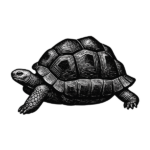

The floorboards didn’t just groan; they hummed with the high-pitched, vibrating shudder of thirty-two feet of oak straining against a swelling Pacific sea.
Down near the cabin floor where my leathery chin rested, the air tasted thick-a slick paste of tallow candle smoke, damp sheepskin, and the sour copper of iron bolts rusting inside the bulkhead. My eyes, filmed over with dry salt haze, tracked the flickering lantern light as it gleamed off the heavy, dark dome of my back.
Snap. Tap-tap-tap.
Cold brass calipers pinched the soft fold of skin right where my neck emerged from my shell. The blunt edge of a human fingernail-caked with dried egg yolk and blue ink-scraped hard against my fifth costal scute.
“Look at the shell’s margin, Wickham,” muttered the young man squatting over me. He didn’t look at my eyes; he looked at me like a cipher waiting to be cracked. His woolen trousers were pulled so taut across his knees that gray threads frayed into tiny fuzzballs against the light. His left eyelid twitched-a fast, nervous flutter every time his brass instrument slipped against my scute.
“The posterior notch isn’t flared like the ones from James Island,” he rasped, his breath smelling of stale tea and pipe smoke. His thumb pressed so hard into the soft flesh behind my leg joint that my back foot twitched, claws clicking against a brass nail head in the planking. “It’s squared off. Saddle-backed.”
Across the table, Captain Wickham picked black weevils out of a heap of hardtack with the point of a pocketknife. Tink. A beetle hit the oak floor.
“It’s meat, Charles,” Wickham said, his voice as dry as cured leather. Yet, his face softened into something strangely gentle as he picked up a slice of dried apple from his pewter plate and held it down toward my beak. “The men haven’t had fresh fat since we left the Galápagos.”
I stretched my neck out, lured by the sweet, leathery aroma of the dried fruit. But Charles snatched the apple slice straight out of Wickham’s fingers. He didn’t offer it to me. He shoved the whole wedge into his own mouth, chewing violently, a bead of sticky yellow juice catching in his reddish stubble.
“We aren’t eating this one,” Charles snapped, spraying flecks of apple skin onto the parchment spread between them.
He didn’t say my name. He hadn’t given me one. Nor was he saving me out of mercy. He didn’t care that my cold reptilian heart thudded in slow, heavy thumps against the floor. He saved me because Captain FitzRoy had called his field notes “amateurish” at breakfast. Saving a specimen that proved the islanders right about shell variations would humiliate the captain before the HMS Beagle rounded the Horn. Vanity tasted sweeter to him than tortoise soup.
“I’m keeping her alive,” Charles declared, scribbling frantic ink lines onto a fresh page. He labeled the drawing with a flourish of his quill, the wet ink gleaming under the lantern: Galápagos Tortoise – Specimen No. 3.
Decades later, under the scorching glare of an Australian sun, humans would call me Harriet. But right then, trapped in the belly of a wooden vessel, I was merely a silent, moss-backed witness to a young Charles Darwin’s spite.
Charles reached out, his thumb catching on a sharp splinter where my shell had scraped against volcanic basalt two moons ago. He didn’t pull back when the wood bit his skin. He just squeezed tighter, smearing a smudge of dark human blood directly onto my scute, sealing my identity into the wood like red wax.
Seven decades evaporated in a blur of shifting tides and changing coastlines. In 1842, Captain Wickham retired, trading the salt-crusted rigging of the Beagle for the sun-drenched dirt of Brisbane. He brought me with him, an ancient souvenir from a voyage that was already rewriting human history.
Australia was hot, vast, and loud. The air smelled of crushed eucalyptus, baked red earth, and ozone before sudden tropical downpours. I grew heavier, my shell expanding until I weighed nearly four hundred pounds-a living boulder in a world that moved far too fast. I watched Wickham grow gray, his hands developing the same tremor Charles once had, before he too faded into the soil. I watched empires crumble across the ocean, watched metallic machines replace horses on paved roads, and watched generations of humans flicker in and out like lightning bugs on a humid night.
By 2006, my home had become a lush sanctuary in Queensland. The world around me had changed beyond recognition, but the sun felt the same on my ancient scutes.
Every afternoon, a large man in khaki shorts would kneel beside me in the dirt. His skin smelled of sunscreen, sweet mangoes, and grass. Steve Irwin didn’t look at me with the frantic, calculating eyes of Charles Darwin, nor the weary appetite of Captain Wickham. When he rested his big, rough hand against my neck, his fingers didn’t pinch or measure. They rubbed the sensitive, wrinkled skin behind my chin until my eyelids drooped in pure bliss.
“How ya holdin’ up, old girl?” he’d whisper, his voice a warm, booming rumble that vibrated straight through my shell. He called me an honorary grandmother.
To the millions of humans who walked past my enclosure, I was a living relic, a link to Darwin’s grand theory. But as I closed my eyes beneath the Australian palms, listening to the soft rustle of the leaves, I knew the truth. I was not just history. I was the quiet stillness in a rushing world-a hundred and seventy-six years of sun, sea, and stories written upon my back.